Gaslit by a Song
I think it was 2001, in Cincinnati or Dayton, OH. I was at a rave; I don’t remember the venue. My friend Tate was about halfway through his set and he played a song I recognized – I had just picked the record up a couple months prior. This was the opening track from Kimball Collins’ “Generation Trance 2000” mix CD: “Imagination (K90 remix)” by Jon the Dentist & Ollie Jaye. It’s a beautiful upbeat trance track with supersaw synth hooks and a driving acid line.
Tate was a very good and experienced DJ; his mixes were tight, track selection was great, and his beatmatching was consistently steady. So it was a surprise, as this song was winding down and the next track was being brought in, when I heard the beats start to drift out of phase.
This probably requires a small explanation, if you’re not familiar with DJing.
“Brief” overview of technical DJing
Most songs, even in electronic music, are not the same exact tempo (measured in beats-per-minute: “BPM”). A DJ could just play a song, then play another song and talk in between them (“radio style”). They could also play a song, and then start the next song during the current song’s outro. But if you really want to blend two songs, the beats need to line up. Typically, this means having both songs playing at the same tempo (e.g. both songs playing at 120 BPM), but you CAN also have one song play at twice, or half, the tempo of the other (one song at 60 BPM and the other at 120 BPM). Other combinations are possible, but equal BPMs is the most straightforward.
Once the songs are playing at the same BPM, they need to also be “in-phase”. This means that the beats are playing at the same time. If you ever sang a song “in rounds” (like in elementary school, when our music class sang “Row, row, row your boat”, where different groups would begin singing at staggered starting points), it’s sort of like that. You want the beats to hit at the same time and you also want the downbeat (beat 1) of each measure also line up. When done correctly, the wave forms look like this:
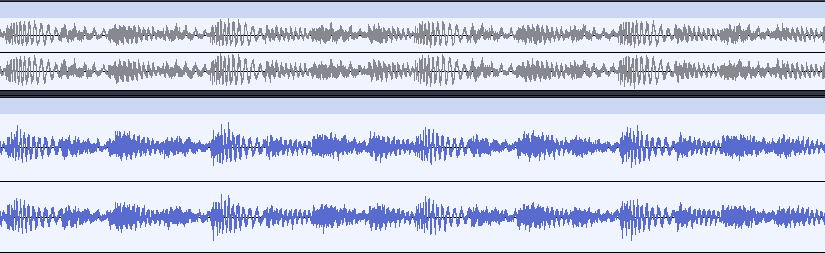
Those are “in-phase”.
A more skilled DJ will also line up the “phrases” (usually 32 or 64 bars long) so that the beginning of an incoming song matches up with the beginning of a phrase in the song that’s playing. It’s a bit cryptic, but here’s a diagram I drew for a DJ workshop I co-led with Dez in 2025:
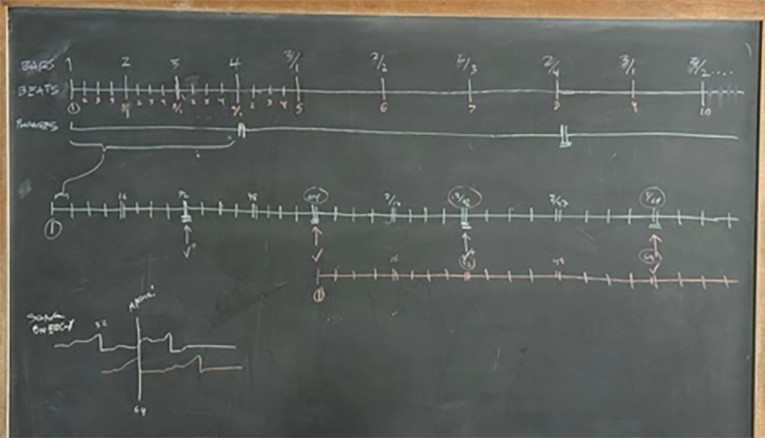
When done correctly, the incoming song will blend, hopefully in a natural-sounding way, with the song that’s being played. For dancers, this can be critical in not breaking groove-immersion.
So in summary, a DJ will:
- Play a record on turntable 1 so that everyone can hear it
- Get the next record on turntable 2, with the fader “closed” and “cue” or “PFL” enabled so only the DJ can hear it in their headphones
- Drop the needle on the record, then locate where downbeat 1 (the “cue point”) is
- Wait until the current song on turntable 1 is approaching the end of the current phrase
- Start playing turntable 2 when beat 1 of the next phrase in turntable 1 begins
- Adjust the tempo of turntable 2 so that it aligns perfectly(*) with turntable 1, to keep the beats in-phase
- When it makes sense, introduce the song on turntable 2
- When it makes sense, fade off the song on turntable 1
- Repeat in the other direction
Granted, things have changed quite a bit since most DJs have transitioned to digital. If you’ve ever heard a DJ talk about “Sync button”, they’re referring to a button that will automate step 6. That’s arguably the hardest technical skill to develop when mixing vinyl. Digital decks also have the ability to set cue points (automating step 3), as well. This can be a big time and effort saver, and frees the DJ up to do things like live re-sampling, looping, re-mixing with separated stems, etc. It’s really cool!
I’m a vinyl purist, but I think the digital stuff is really cool, even with the sync button. My main complaint about digital DJing is that people learn how to do steps 1-9 above, mimicking vinyl DJing, and then don’t take it any farther. There’s so much cool stuff that can be done, musically.
Back to the rave!
Out of phase
So Tate, an experienced DJ, had an unexpected train wreck (his beats were falling out of phase, giving it that ba-dump, b-dump, bdump, b-dump, ba-dump sound). The wave-form looks like this – compare it with the in-phase example above.
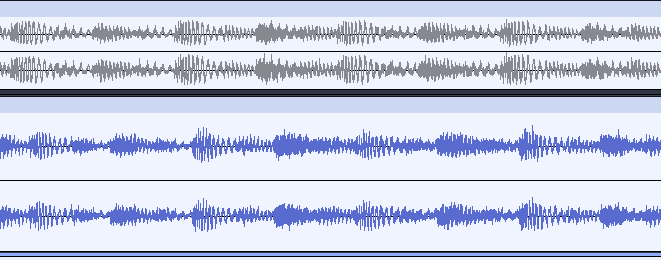
Not a huge deal, and the rest of his set was fantastic. It’s quite possible no one except other DJs even noticed.
However, the key thing for me was that I had experienced the same challenge with this specific song. I had a few years less experience than he did so I just assumed it was a skill issue.
After his set, I caught up with him and said something like “dude that k90 remix is hard to mix isn’t it?”
I think he replied something like “Yeah! I swear the tempo changes near the end!”
I have sat on this record for literally decades, never playing it live but making a few attempts in my studio and always encountering the same issue, at the same point in the song. This month I’ve been practicing for a gig I have tonight (at the time of writing this) and had resolved “I’m going to figure this out.” I’ve developed much more skill since 25 years ago, surely I can do this now… right?
An experiment
This month, I have 5-10 practice recordings where I have attempted to use that song as an opener and mix another song into it. There is a natural inflection in the song that is the ideal cue point to start the next song, it’s about 128 bars from the end. That also seems to be where the tempo gets the most wobbly.
My specialty, as a DJ, is long-blends – 1-3 minutes for some songs, where two songs are playing at the same time. This is a skill I practice very specifically. When I say “I had these songs locked and then they suddenly started drifting out of phase,” please understand how bewildering this is – normally, if I fuck up a mix, I can tell “oh I didn’t have the beats matched right.” There’s something else going on here.
Right…? I’m not going crazy, I swear.
So I thought of an experiment:
- Record my vinyl record of this song, at it’s natural tempo
- Record the digital version from the internet
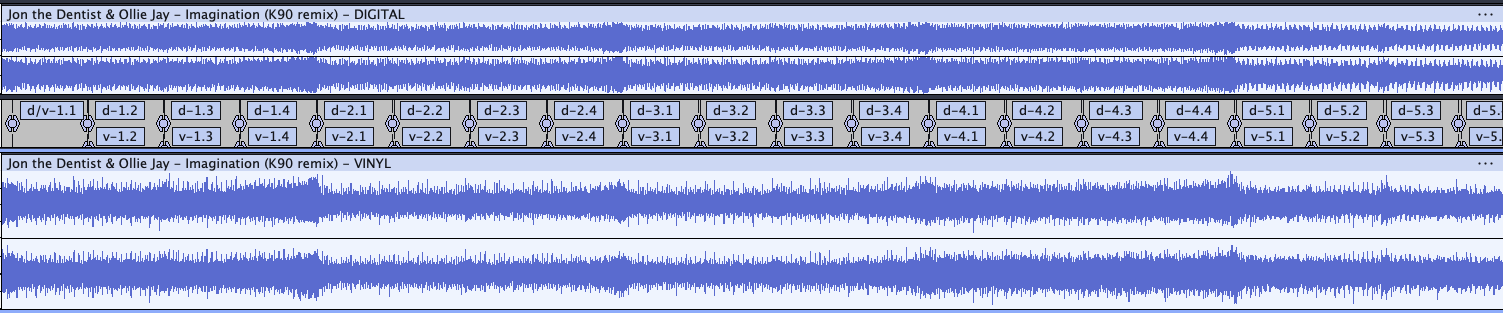
- Load both into Audacity (audio editing software)
- Compare waveforms
Questions I want to answer:
- Are the vinyl and digital versions actually the same?
- Does the vinyl version have tempo drift?
- Does the digital version have tempo drift?
Methodology:
- Use a label track (allows for timecoded annotations to match audio tracks in Audacity) to mark downbeats
- Identify a clear and apparent initial point to sync the two tracks up (a crash cymbal on a downbeat, eg.)
- Measure the duration of 4-bar segments and compute the BPM using the formula:
(16 beats / duration) * (60 seconds / minute) - Measure the duration of a longer duration (16 bars or so) and compute the BPM of that
- Compare the longer BPM computation with the individual shorter segments
I am not expecting exactly correct numbers – the labelling process isn’t perfect, but should be pretty close. The drift I am experiencing when mixing has required adjustments as much as +/- 1%, which at ~140bpm initially means 1 to 2 BPM difference.
Data

| Bar | Digital | segment (D) | BPM (D) | Vinyl | segment (V) | BPM (V) |
|---|---|---|---|---|---|---|
| 1.1 | 04:10.907 | - | - | 04:10.907 | - | - |
| 1.2 | 04:17.894 | 00:06.987 | 137.40 | 04:17.906 | 00:06.999 | 137.16 |
| 1.3 | 04:24.867 | 00:06.973 | 137.67 | 04:24.890 | 00:06.984 | 137.46 |
| 1.4 | 04:31.911 | 00:07.044 | 136.29 | 04:31.944 | 00:07.054 | 136.09 |
| 2.1 | 04:38.960 | 00:07.049 | 136.19 | 04:39.004 | 00:07.060 | 135.98 |
| 2.2 | 04:46.010 | 00:07.050 | 136.17 | 04:46.067 | 00:07.063 | 135.92 |
| 2.3 | 04:53.060 | 00:07.050 | 136.17 | 04:53.128 | 00:07.061 | 135.96 |
| 2.4 | 05:00.011 | 00:06.951 | 138.11 | 05:00.190 | 00:07.062 | 135.94 |
| 3.1 | 05:07.167 | 00:07.156 | 134.15 | 05:07.256 | 00:07.066 | 135.86 |
| 3.2 | 05:14.192 | 00:07.025 | 136.65 | 05:14.292 | 00:07.036 | 136.44 |
| 3.3 | 05:21.243 | 00:07.051 | 136.15 | 05:21.355 | 00:07.063 | 135.92 |
| 3.4 | 05:28.294 | 00:07.051 | 136.15 | 05:28.415 | 00:07.060 | 135.98 |
| 4.1 | 05:35.344 | 00:07.050 | 136.17 | 05:35.461 | 00:07.046 | 136.25 |
| 4.2 | 05:42.392 | 00:07.048 | 136.21 | 05:42.550 | 00:07.089 | 135.42 |
| 4.3 | 05:49.452 | 00:07.060 | 135.98 | 05:49.604 | 00:07.054 | 136.09 |
| 4.4 | 05:56.494 | 00:07.042 | 136.32 | 05:56.658 | 00:07.054 | 136.09 |
| 5.1 | 06:03.546 | 00:07.052 | 136.13 | 06:03.720 | 00:07.062 | 135.94 |
| 5.2 | 06:10.434 | 00:06.888 | 139.37 | 06:10.627 | 00:06.907 | 138.99 |
| 5.3 | 06:17.325 | 00:06.891 | 139.31 | 06:17.531 | 00:06.904 | 139.05 |
| 5.4 | 06:24.213 | 00:06.888 | 139.37 | 06:24.426 | 00:06.895 | 139.23 |
| 6.1 | 06:31.102 | 00:06.889 | 139.35 | 06:31.403 | 00:06.977 | 137.59 |
| Final | 02:20.195 | 00:07.010 | 136.95210 | 02:20.496 | 00:06.690 | 136.65869 |
Final calculation was made by subtracting the final timestamp from the initial, then taking the total number of segments (20) x the number of bars in each segment (4) x the number of beats in each bar (4) => 320. This gives the average BPM across the full duration.
Drift across versions
This is vindicating.
I did double-check the cue marks around a few of those spots where it deviates significantly from the total average; they appear to be correct.
Before I dive into the details, I want to point out that although the total duration is NEARLY IDENTICAL (0.3s difference!), look at how the first bar (1.1) looks, phase-wise, compared to halfway (3.4):
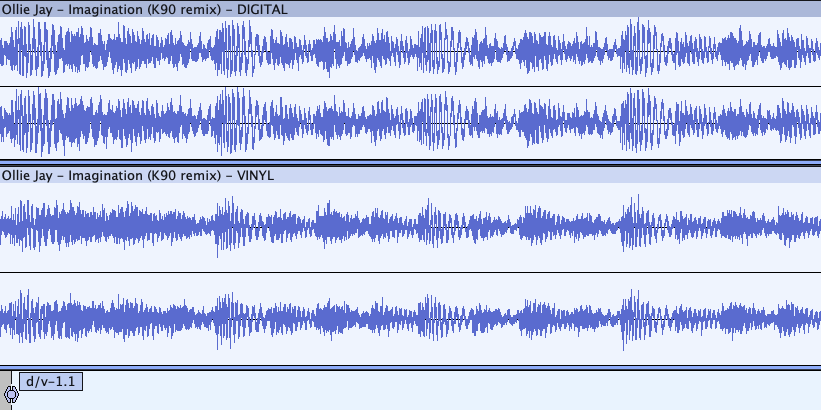
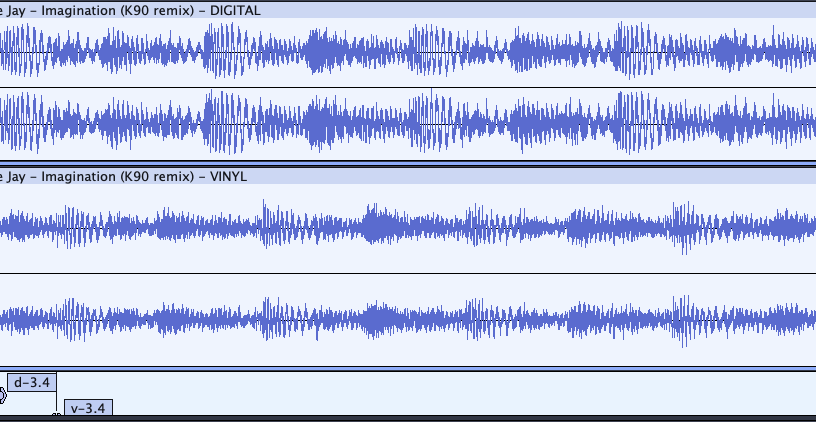
If you’re unfamiliar with reading audio waveforms: the bulbous part is the bass-kick. The top pair is the stereo channels (left and right) for the digital version, and the bottom is the stereo channels for the vinyl version. If things are in-phase, as they are in the first image, then all four of those bulbous waves should line up perfectly. Notice how far apart they are even by the midpoint!
If we round off and say the BPM is 137, then there are 60 seconds for every 137 beats, or one beat every 0.438 seconds (60/137 => 0.4378562). In the 3.4 image above, beat 1 (right after the cue mark) of the vinyl side is lagging back from the digital one by 0.128s. Looking at the waveform, in the digital lane, the smaller crest between the two bass kicks (which are quarter-notes) would be on an eighth-note. Since the vinyl lane beat happens directly between those two, that puts it roughly on a sixteenth note. This is very audible.
By 5.4, the gap has grown to 0.213s (pretty much a full eighth note).
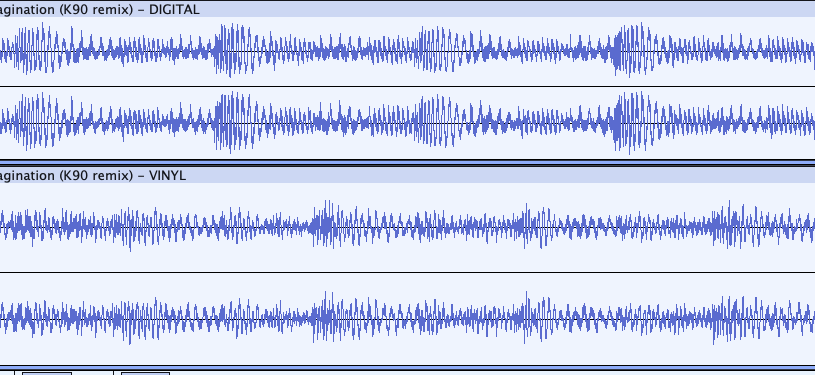
So the vinyl and digital versions both play 80 bars within 0.3s the same time (less than 1 beat difference, or 0.3125% drift). My guess here is that for whatever reason, the digital version is at a slightly (and I mean slightly faster BPM). Weird flex, but OK.
Drift within versions
Now this part was really crazy. Look at the calculated BPM at digital 2.4. I had to triple check this cue mark and 2.3 and 3.1 as well to make sure I wasn’t off – they all check out! 136 BPM -> 138 BPM is a 1.8% increase in tempo. This may not seem like much, but on a Technics 1200 turntable, the pitch control can only go +/- 8%. Even tiny adjustments on this will become very evident after a few bars.
Then at 3.1 it slows down to 134 BPM, and then levels back off to 136 BPM. This tracks with what I experience, hearing it – it gets suddenly faster and then suddenly slower and then suddenly faster again. Same thing again around 5.1 through 5.4, jumping to 139 BPM. 5.1 happens to be the natural cue point, when I would want to start playing the next song.
I just checked the duration of that segment – 5.1 through the end of 5.4 (so 16 bars total, or 64 beats) is 27.555s on digital and 27.682s on vinyl. Converting that to BPM we get 139.357 BPM (64 / 27.555 * 60) and 138.718 (64 / 27.682 * 60), respectively. Comparing this to 1.1 through the end of 1.4 (28.054 on digital, 28.098 on vinyl) we get 136.879 (64 / 28.054 * 60) and 136.665 (64 / 28.098 * 60), respectively.
| Segment | Duration (D) | BPM (D) | Duration (V) | BPM (V) |
|---|---|---|---|---|
| 5.1-5.4 | 27.555s | 139.357 | 27.682s | 138.718 |
| 1.1-1.4 | 28.054s | 136.879 | 28.098s | 136.665 |
That’s a huge difference – 1.8%. This means if I have a normal record that doesn’t have weird drift like this, and it’s playing at, say, 136.8 BPM, when this track suddenly jumps to 139.4 BPM, the beat will be off by 2.6 BPM, or 0.007s (60/136.8 => .4385s, and 60/139.4 => .4315).
Comparing with a click track
Here this will make it clearer.
I found a metronome click track and set it to 136.13 BPM, then I lined it up with the cue-marker for 4.3 (the BPM looks at the delta of the previous 4 bars, so it would be 4.3 - 5.1 that is that BPM) See how they match exactly?
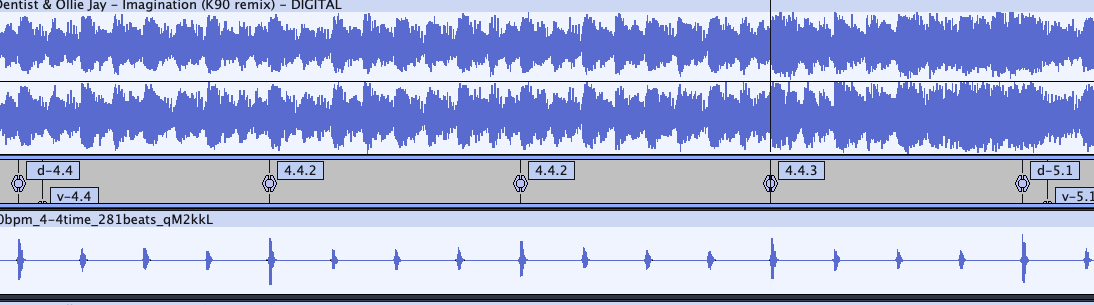
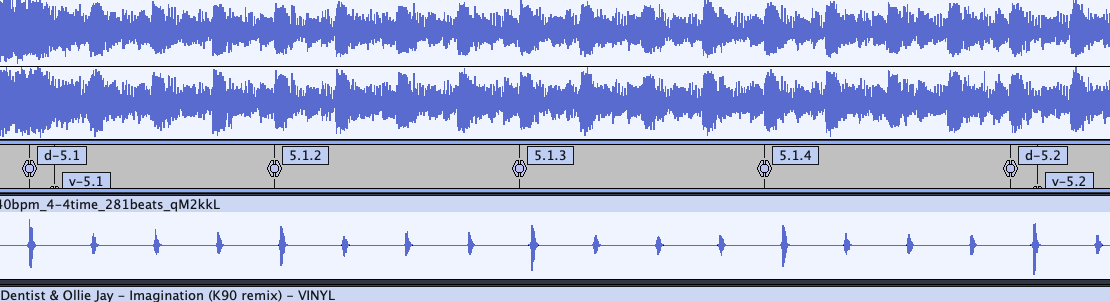
Now, without moving that click track at all, look what happens from 5.1 to 5.2. Notice how the click vertical lines quickly deviate from the cue-markers I added for each bar? Those should line up pretty much exactly if the tempo were steady.
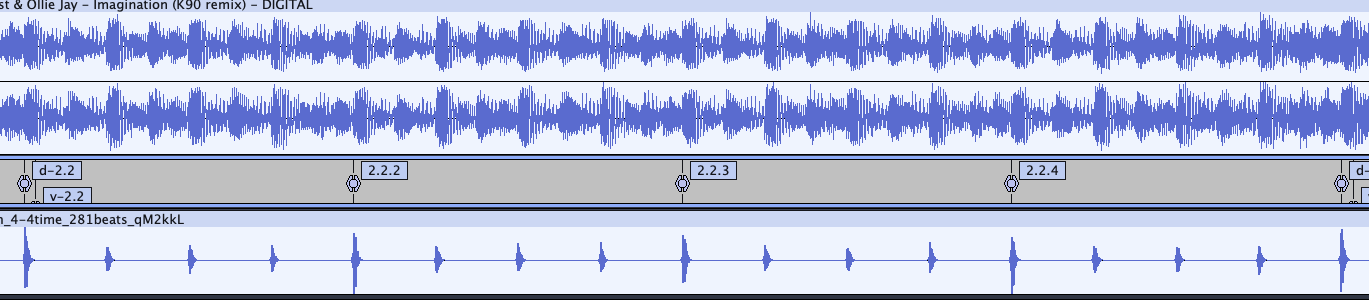
For comparison, I adjusted the click track to be 136.17 (the tempo used for segments 2.1 and 2.2, in the table above), aligned it on beat 1 in the same way. Notice how each of the clicks lines pretty much perfectly with every one of the clicks? This is the way it’s supposed to be.
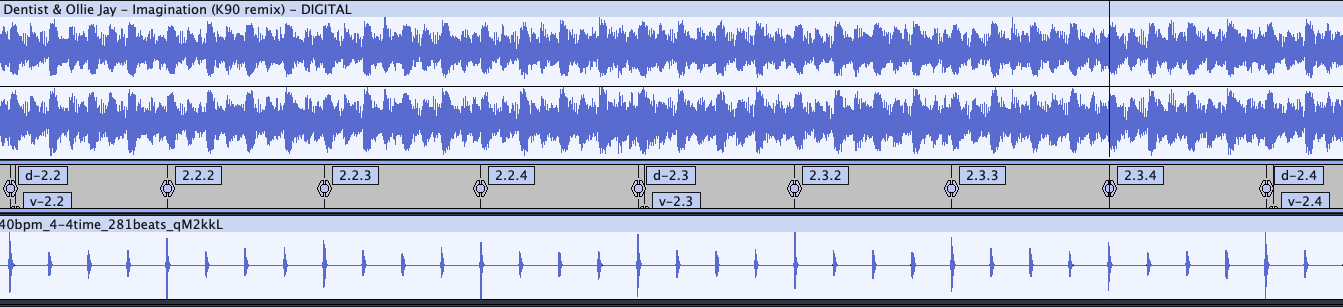
We can even zoom out and see two bars where it remains rocksteady through all of them:
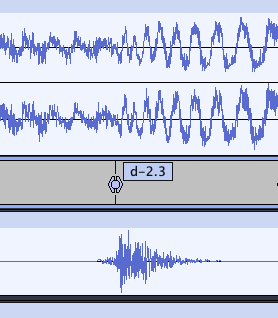
Or zoom in on the first beat of 2.3 – still matching!
It still blows my mind that even on the digital release of this song, this BPM drift occurs.
This song will remain on my shelves, probably
Now that I know this for certain, I will probably not ever play it. Or if I did, I certainly wouldn’t try to blend another song with it. It’s a bit sad because the song is a really great anthem track. I don’t know if any later releases also had this issue or not.
I’ve considered it’s possible that it’s an issue with the quartz clock on my turntable (that it’s not steady), but if this were the case I would have the same drift issues with every other record, which I do not.
So Tate, wherever you are out there – it’s not just us! The track is faulty!
Also, to Jon the Dentist aka John Vaughan: bruh, I have loved your music since forever and I own at LEAST a dozen of your releases on vinyl… but WTF man?